

What SEER Rating Do I Need in Florida?
If you’re in Florida, choosing the right SEER rating for your air conditioning system is crucial for balancing energy efficiency, cost, and comfort. SEER, or Seasonal Energy Efficiency Ratio, measures how efficiently your AC uses electricity to cool your home. Higher SEER ratings mean lower energy costs but come with higher upfront prices. Here’s what you need to know:
- Florida's Minimum Requirement: As of 2026, new AC systems must meet a minimum of 14.3 SEER2 (equivalent to 15 SEER under the old standard).
- Best Choices:
- 16 SEER (15.2 SEER2): Affordable, reliable, and meets state standards.
- 18 SEER (17 SEER2): Better efficiency, ideal for larger homes or higher cooling demands.
- 20+ SEER: Premium systems with maximum efficiency, better for long-term savings.
- Cost vs. Savings: Upgrading from a SEER 15 to SEER 20 system can save about $156/year in energy costs, but higher-SEER systems have a longer payback period.
- Humidity Control: Systems with SEER 18+ often include variable-speed compressors, which improve dehumidification - important for Florida’s humid climate.
Key Tip: Proper installation and ductwork are just as important as SEER ratings. Even a high-SEER system won’t perform well if installed incorrectly or paired with leaky ducts.
For Florida homeowners, investing in a system with a SEER rating that fits your home size, cooling needs, and budget ensures comfort and energy savings over time.
AC Efficiency in 2025… Which SEER rating should you buy⁉️
sbb-itb-ab7d5a1
What Is a SEER Rating?
SEER, or Seasonal Energy Efficiency Ratio, measures how effectively your air conditioner converts electricity into cooling over an entire season. It’s calculated by dividing the total cooling output (measured in BTUs) by the total electrical energy consumed (in watt-hours) under standard outdoor conditions.
In simple terms, the higher the SEER rating, the more cooling your system delivers per unit of electricity. For Florida homeowners, this efficiency translates directly into savings. For instance, a 3-ton air conditioner with a SEER rating of 20 costs approximately $468 per year to run in Florida. Compare that to a SEER 15 system, which costs about $624 annually. That’s a yearly difference of about $156.
SEER vs. SEER2 Testing Standards
As of January 1, 2023, the Department of Energy introduced a new testing standard called SEER2. This updated method provides a more accurate reflection of how systems perform in real-world conditions. SEER2 testing factors in higher external static pressure, which simulates the resistance air encounters when moving through typical residential ductwork. Because of this adjustment, SEER2 ratings tend to be about 4%-5% lower than their SEER counterparts.
When shopping for a new air conditioning system, it’s important to compare SEER2 ratings with other SEER2 ratings, rather than mixing old SEER data with the new standard.
Why SEER Matters in Florida's Climate
Florida's hot, humid weather makes SEER ratings especially relevant. With air conditioners running for roughly 2,000 hours annually in a typical Florida home, small efficiency differences can lead to noticeable changes in energy costs. Given that residential electricity rates averaged $0.1521 per kWh in 2023, choosing a higher SEER system can make a big impact.
Systems with SEER ratings of 18 or higher often come with variable-speed compressors. These not only boost efficiency but also improve dehumidification - crucial for Florida’s muggy climate. On the other hand, single-speed systems operate at full power during cycles, which can allow indoor humidity to rise when the system shuts off.
Next, we’ll dive into Florida’s specific SEER requirements and how they affect your home.
Florida's Minimum SEER Requirements
Florida falls under the Southeast/Southwest classification, which enforces stricter efficiency standards due to the state's high cooling demands and extended air conditioning seasons. These guidelines are crucial for understanding the updated requirements for new AC installations.
2025-2026 SEER Regulations
Starting in 2026, any new or replacement air conditioning system installed with a permit in Florida must meet specific SEER2 ratings. For residential split systems under 45,000 BTUs, the minimum requirement is 14.3 SEER2, which aligns with the older 15 SEER standard. Residential packaged units must achieve ratings between 13.4 and 13.8 SEER2, depending on their configuration.
These standards are not optional. Florida's building inspection process enforces compliance, and systems that fail to meet these requirements will not pass inspection. As one HVAC expert in Florida explains:
"Florida's permitting requirements trigger current code compliance at the time of permit issuance. Replacement systems installed under permit must meet the efficiency standards in force at permit issuance - not the standards that applied when the original system was installed."
To ensure compliance, ask your contractor for an AHRI certificate that confirms your unit meets Florida's 14.3 SEER2 minimum requirement. Not only does this guarantee your system adheres to state regulations, but it also helps you maximize energy efficiency and cost savings. Keep in mind, non-compliant systems are not eligible for utility rebates or federal tax credits, which could mean missing out on significant financial benefits.
Factors That Determine Your Ideal SEER Rating
Meeting Florida's minimum 14.3 SEER2 requirement is just the starting point. Choosing the right SEER rating for your AC system involves understanding your home's unique needs and usage habits. This ensures you don’t overspend on features you won’t use or skimp on efficiency that could save you hundreds annually.
Home Size and Cooling Needs
The size of your home plays a major role in determining its cooling load - the amount of heat your AC needs to remove. While SEER ratings measure efficiency, the system's capacity (measured in tons) must align with your home’s specific requirements. This is calculated through a professional Manual J load calculation.
Larger homes with higher-tonnage systems benefit more from higher SEER ratings in terms of dollar savings. Smaller systems, while still efficient, won’t deliver the same absolute savings even if the percentage improvement is the same.
The number of people in your home also matters. Larger households naturally generate more heat from activities like cooking and showering, increasing cooling demands. In such cases, opting for a higher SEER2 rating (18–20) often makes financial sense because of the system's increased runtime.
"Sizing the air conditioner close to the actual load (cooling requirement) provides better humidity control and typically results in energy savings when compared to an oversized air conditioner." - Wendell A. Porter, University of Florida
Avoid oversizing. A high-SEER system that’s too large for your home can lead to "short-cycling", where the unit constantly turns on and off. This reduces efficiency and can leave your home feeling damp despite cooler temperatures.
Once your system is properly sized, check that your insulation and ductwork are optimized to fully take advantage of your AC’s efficiency.
Insulation and Ductwork Efficiency
A high SEER rating reflects the potential efficiency of the unit, but that potential can be wasted if your home’s ductwork or insulation isn’t up to par. On average, duct systems lose 25% to 40% of the cooling energy generated by the AC. Even a 20% duct leakage can force your system to work 50% harder.
"A SEER 16 system installed correctly will outperform a SEER 20 system with improper refrigerant charge, poor airflow, or duct leaks." - Central Air Systems
Before investing in a premium SEER2 20+ unit, ensure your ductwork is sealed using mastic or UL-181 rated foil tape (not standard duct tape, which breaks down quickly). Also, confirm that your attic insulation meets Florida’s recommended R-values. A well-sealed mid-range system often outperforms a poorly installed high-efficiency system.
Leaking return ducts are particularly troublesome in Florida. They can pull hot, unconditioned air from attics or crawlspaces into your home, increasing the cooling load and negating any benefits of a high-efficiency system. Always request a Manual J load calculation that takes into account your home’s insulation, windows, and ductwork rather than relying solely on square footage.
Usage Patterns and Energy Goals
How you use your AC also plays a big role in determining whether a higher SEER rating is worth it. For example, setting your thermostat below 78°F increases cooling costs by about 8% for every degree lower. If you prefer cooler indoor temperatures, such as 72°F instead of 78°F, a higher SEER system becomes more cost-effective due to the increased runtime.
Your timeline for staying in your home is another key factor. High-SEER systems (20+) may take years to offset their higher upfront cost through energy savings. If you plan to move within 2–5 years, a mid-range SEER2 system (15.2–16.2) often offers the best balance of cost and reliability. However, long-term residents are more likely to see a return on investing in premium efficiency.
For households where someone is home all day or consistent temperatures are maintained, variable-speed systems (typically 18+ SEER) are a great choice. These units run longer at lower speeds, offering better humidity control and more consistent temperatures throughout your home. If your main priority is comfort - even temperatures and low humidity - rather than minimizing utility bills, variable-speed systems are ideal for handling Florida’s humid climate.
Also, check for potential savings through federal tax credits under the Inflation Reduction Act (available through 2032) or local utility rebates. These incentives can help offset the higher cost of high-efficiency systems.
Recommended SEER Ratings for Florida Homes
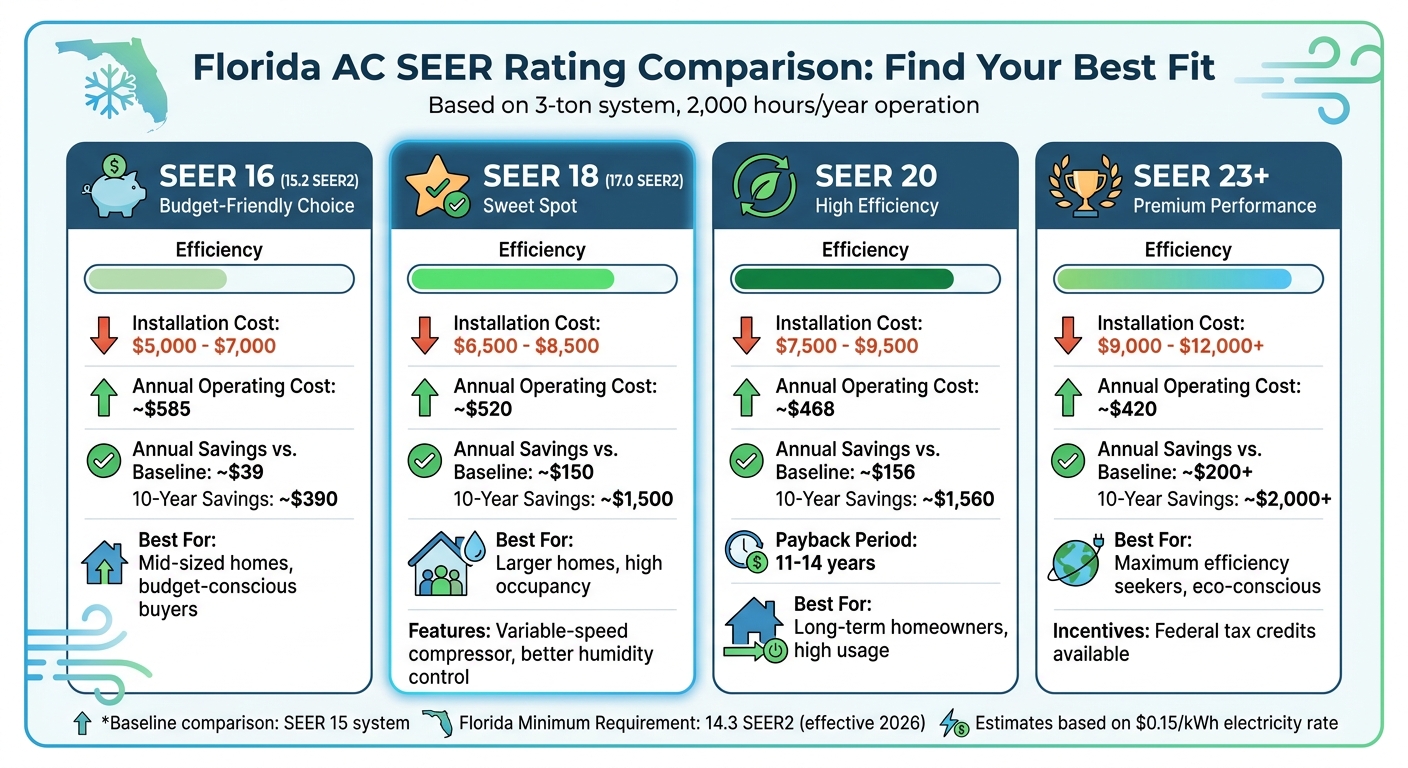
Florida AC SEER Rating Comparison: Costs and Savings Guide
Choosing the right SEER rating for your air conditioning system is essential when balancing energy efficiency, cost, and Florida's intense cooling demands. Here's a breakdown of recommended SEER ratings based on typical home sizes and usage patterns.
16 SEER (15.2 SEER2): Affordable and Dependable
A SEER 16 (15.2 SEER2) system is a budget-friendly choice for mid-sized homes, meeting Florida's minimum efficiency standards while keeping upfront costs reasonable. Installation costs typically range from $5,000 to $7,000, and the system delivers reliable performance without the higher price tag of more advanced models. For a standard 3-ton system running 2,000 hours annually, operating costs are estimated at $585 per year - about $39 less than a baseline SEER2 15 system.
To maximize efficiency, proper installation and sealed ductwork are critical. In fact, a well-installed SEER 16 system can outperform a poorly installed higher-efficiency unit in real-world conditions.
If your home is larger or your cooling needs are higher, stepping up to a SEER 18 system might be a better fit.
18 SEER (17.0 SEER2): Ideal for Larger Homes
For many Florida households, a SEER2 18 system (roughly equivalent to 19 SEER) offers a great middle ground between upfront costs and energy savings. Installation costs generally fall between $6,500 and $8,500, which is about $1,500 to $2,000 more than a baseline system. These systems often feature variable-speed or two-stage compressors, which improve comfort by maintaining consistent indoor temperatures, reducing noise, and enhancing humidity control - an important feature in Florida's humid climate.
Annual operating costs for a 3-ton system running 2,000 hours are estimated at $520, saving about $150 per year compared to a baseline SEER2 15 unit. This makes the SEER 18 system a solid choice for larger homes, households with higher daytime occupancy, or anyone prioritizing comfort and efficiency.
For those planning to stay in their homes for the long term and seeking maximum energy savings, the next tier may be worth considering.
20+ SEER: Top Efficiency for Long-Term Savings
If you're looking for the highest efficiency and are prepared for a larger upfront investment, SEER2 20+ systems deliver exceptional performance. Installation costs for SEER2 20 units range from $7,500 to $9,500, while premium models rated SEER2 23+ can cost $9,000 to $12,000 or more. These systems reduce annual operating costs to around $468, saving approximately $156 per year compared to a baseline SEER2 15 unit.
While the energy savings are appealing, the higher upfront cost means it could take 11 to 14 years to recoup the investment through reduced utility bills - sometimes longer than the system's expected lifespan. Over 12 years, a SEER2 20 system could save about $1,872, but the initial cost premium of $2,500 to $5,000 must be factored in.
These systems are ideal for homeowners with high energy usage, those planning to stay in their homes long-term, or anyone focused on reducing their environmental impact. Additionally, they may qualify for federal tax credits (up to $2,000 under the Inflation Reduction Act) or local utility rebates. Variable-speed technology further enhances comfort and humidity control, making these systems particularly appealing for Florida's climate.
| SEER2 Rating | Installed Cost | Annual Cooling Cost* | Annual Savings vs. Baseline (15 SEER) |
|---|---|---|---|
| 16 | $5,000 – $7,000 | ~$585 | ~$39 |
| 18 | $6,500 – $8,500 | ~$520 | ~$150 |
| 20 | $7,500 – $9,500 | ~$468 | ~$156 |
| 23+ | $9,000 – $12,000+ | ~$420 | ~$200+ |
*Estimates based on a 3-ton system operating 2,000 hours per year at Florida electricity rates.
Energy Savings and Cost Comparison
When it comes to cooling homes in Florida, where demand can be intense, comparing energy costs across different SEER ratings is essential. These comparisons help homeowners decide whether the higher upfront cost of a more efficient system is worth the potential savings on electricity bills. While high-efficiency systems may come with a steeper price tag initially, they can lead to noticeable reductions in monthly energy expenses, potentially covering the extra investment over time.
Sample Energy Savings by SEER Rating
Here’s a breakdown of estimated annual cooling costs for a typical 3-ton (36,000 BTU) system in Florida, based on 1,200 cooling hours per year and an average electricity rate of $0.15/kWh:
| SEER Rating | Estimated Annual Cost (3-Ton)* | Annual Savings (vs. SEER 14) | 10-Year Savings |
|---|---|---|---|
| 14 SEER | $462.86 | – | – |
| 16 SEER | $405.00 | $57.86 | $578.60 |
| 18 SEER | $360.00 | $102.86 | $1,028.60 |
| 20 SEER | $324.00 | $138.86 | $1,388.60 |
*These calculations are based on a 36,000 BTU system, 1,200 cooling hours annually, and a $0.15/kWh electricity rate.
This formula factors in the system's capacity (BTU), annual cooling hours, SEER rating, and local electricity rates to estimate yearly energy consumption. Since heating and cooling typically account for over 40% of a household's energy bill in Florida, even small efficiency improvements can lead to significant savings over time.
It’s worth noting that savings diminish as SEER ratings increase. For instance, upgrading from SEER 10 to SEER 16 can cut energy costs by 37%, while moving from SEER 16 to SEER 22 provides an additional 27% savings.
Now, let’s examine how these savings stack up against the initial investment.
Upfront Costs vs. Long-Term Benefits
Higher-SEER systems generally require a larger upfront investment, but the long-term savings can balance out the expense. The key factor is how long you plan to stay in your home. For example, a SEER 20 system can save around $1,872 in energy costs over 12 years compared to a SEER 15 system. However, the initial price difference for high-efficiency units can range from $2,500 to $5,000, meaning the payback period may extend to 11–14 years. For many homeowners, this timeframe might feel longer than ideal.
"Higher-SEER systems have greater upfront costs but lower operating expenses. The question is whether energy savings over the system's lifetime justify the higher purchase price." – Central Air Systems
To determine if the investment is worth it, divide the upfront cost difference by the annual savings to calculate the payback period. Many homeowners consider a 5–10 year payback timeframe reasonable.
Additionally, federal tax credits under the Inflation Reduction Act can help offset up to 30% of the cost (capped at $600) for qualifying high-efficiency units. Some local utility companies also offer rebates, which can further reduce the effective cost. However, proper installation is critical - a well-installed SEER 16 system can outperform a poorly installed SEER 20 system.
How West Florida Air Can Help You Choose the Right SEER Rating
West Florida Air simplifies the process of selecting the right SEER rating by offering expert guidance tailored to your specific needs. Choosing the right system involves balancing your home's cooling requirements, budget, and how long you plan to stay in the property. Their team ensures your choice not only meets your expectations but also aligns with Florida's stringent energy standards.
Free Evaluations and Expert Recommendations
West Florida Air provides free home evaluations that include detailed Manual J load calculations. These calculations are essential for determining the exact cooling capacity your home requires, helping to avoid energy waste caused by improperly sized units.
"Skipping a Manual J load calculation can lead to costly inefficiencies." – HALOFIX Team, HVAC Specialists
During these evaluations, technicians assess key factors like ductwork efficiency, insulation quality, window performance, and occupancy levels - all of which influence your home's cooling needs. Given Florida's high humidity, they prioritize systems with advanced dehumidification capabilities and variable-speed compressors. These systems run longer at lower speeds, ensuring consistent comfort while managing humidity effectively. For homeowners planning to stay in their property for over 11 years, a SEER2 20+ system may be recommended to maximize long-term energy savings.
After completing the evaluation, West Florida Air provides tailored recommendations and offers financing options to make your investment more manageable.
SEER-Compliant Installations and Financing Options
All installations performed by West Florida Air comply with Florida's minimum SEER2 15 requirement for systems under 45,000 BTU/h. Their team focuses on the quality of the installation, ensuring proper refrigerant levels and optimal airflow. These factors are crucial because poor installation can significantly reduce a system's efficiency.
"Proper installation is critical to achieving rated efficiency." – Central Air Systems
To make high-efficiency systems more accessible, West Florida Air offers flexible financing options, including 0% APR for qualified customers. They also assist homeowners in taking advantage of federal tax credits and local utility rebates from providers like Florida Power & Light and Duke Energy. These incentives help offset initial costs, making it easier to enjoy the energy savings and reduced expenses that come with a high-efficiency system while staying compliant with Florida's energy regulations.
Conclusion
Choosing the right SEER rating is about finding the sweet spot between cost, energy savings, and comfort - especially in Florida’s demanding climate. While the state’s minimum efficiency standard for residential split systems is 14.3 SEER2, many homeowners prefer systems in the 15.2–18.0 SEER2 range for their balance of efficiency and affordability. For those planning to stay in their homes for more than a decade, units with SEER2 ratings of 20 or higher offer exceptional efficiency and long-term savings.
As mentioned earlier, professional load calculations and quality installation are essential. Even the most efficient system won’t perform as expected if it’s not properly sized or installed. Considering that HVAC systems account for over 40% of the average utility bill in Florida, investing in expert installation and accurate load assessments ensures better performance and energy savings over time.
West Florida Air can simplify this process for you. Their free evaluations include precise load calculations and personalized recommendations, so you can choose a system that matches Florida’s unique demands. Plus, with flexible financing options - like 0% APR for qualified customers - and guidance on federal tax credits and local utility rebates, upgrading to a high-efficiency system has never been more accessible.
Get in touch with West Florida Air today to schedule your free evaluation and find the perfect SEER rating for your Florida home.
FAQs
Is SEER2 the same as SEER?
SEER2 isn't just a rebranding of SEER; it's a newer and more precise way to measure energy efficiency. Designed to enhance accuracy, SEER2 offers a clearer picture of how well systems perform.
In Florida, the Department of Energy now mandates a minimum SEER2 rating of 14.3, which is roughly equivalent to a 15-SEER rating under the older system. While both metrics relate to energy efficiency, SEER2 provides a more detailed and reliable assessment.
Will higher SEER help with Florida humidity?
Higher SEER ratings (Seasonal Energy Efficiency Ratio) can enhance cooling efficiency, which is a big plus in Florida's sweltering heat. This improved efficiency often translates to lower energy consumption. However, when it comes to tackling Florida's infamous humidity, there's another key factor to consider: the Sensible Heat Ratio (SHR).
The SHR determines how effectively an air conditioning system balances cooling and moisture removal. Even with a high SEER rating, a system won't perform well in Florida's humid climate if it's not equipped to handle moisture. So, while a high SEER unit can save energy, it's crucial to ensure the system is also designed to manage both temperature and humidity effectively.
How do I know what SEER is worth the cost?
A SEER rating of 15 or higher can reduce cooling costs by as much as 40% in Florida's intense heat. While these systems might come with a higher initial price tag, the long-term energy savings can make them a smart financial decision. To choose the right option, weigh your budget, energy requirements, and the demands of Florida's climate to find the ideal mix of efficiency and affordability.