
When to Repair vs. Replace Your AC Unit
If your air conditioner isn't working, deciding whether to repair or replace it can save you money and improve your home's comfort. Here’s a quick breakdown:
- Age of the Unit: AC systems in hot climates like Florida last about 10–15 years. If yours is over 10 years old, replacement might be more cost-effective.
- Repair Costs: Use the "$5,000 Rule" (age × repair cost). If the result exceeds $5,000, consider replacing. Also, if repairs cost more than 50% of a new system, replacement is smarter.
- Efficiency: Older units (10 SEER or less) cost more to run. Upgrading to a modern system (16+ SEER) can cut energy bills by 20–40%.
- Refrigerant Issues: Systems using outdated R-22 refrigerant are costly to maintain. Replacement is often the better option.
- Frequent Repairs: If your unit needs multiple repairs within a few years or struggles to cool effectively, replacement is likely the best choice.
Key Takeaway: If your AC is old, inefficient, or expensive to repair, replacing it can save you money in the long run. For newer systems with minor issues, repairs are usually the better option. Always weigh costs and energy efficiency before deciding.
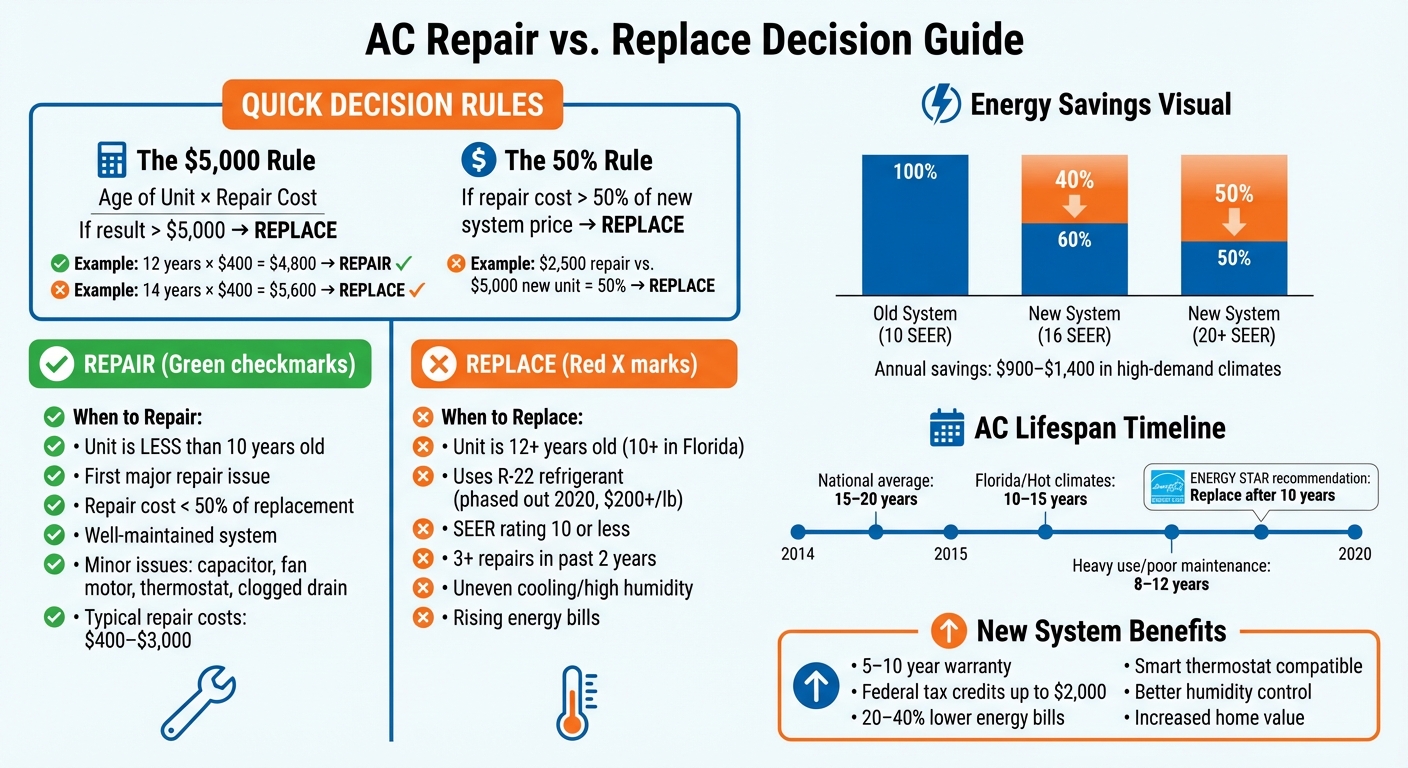
AC Repair vs Replacement Decision Guide: Cost Rules and Key Factors
HVAC Repair vs. Replacement Cost: The $5,000 Rule Explained
sbb-itb-ab7d5a1
Check Your AC Unit's Age
How old is your air conditioner? Its age plays a big role in deciding whether to repair or replace it. Most residential AC units last around 15–20 years. But in Florida, where the climate is tough on systems, that lifespan drops to about 10–15 years. With heavy use or lack of maintenance, some units may only last 8–12 years.
"We typically see lifespans of units in the Deep South being shorter than those in the North because they're used year-round."
– Mike Lea, Co-owner, Lea Heating & Air Conditioning
Once your unit hits the 10-year mark, it’s wise to start planning for a replacement - even if it’s still running. As systems age, they lose efficiency, your energy bills climb, and cooling becomes uneven. Understanding how age affects performance and costs is crucial for making the right decision.
Age and Performance Decline
Florida’s heat and humidity are especially hard on air conditioners. Over time, key components like compressors weaken, coils corrode, and motors have to work overtime to keep up. An older unit not only struggles to cool effectively but also uses more energy to maintain comfort, which means higher utility bills every month.
ENERGY STAR® suggests replacing air conditioners that are more than 10 years old. After a decade - especially in high-demand states like Florida - AC systems become less reliable and much less efficient. If you live near the coast, salt air can make things even worse by speeding up the corrosion of outdoor condenser coils and electrical parts, further cutting down the unit’s lifespan.
Refrigerant Phase-Outs and Costs
Older air conditioners come with another problem: outdated refrigerants. Units installed before 2010 typically use R-22 refrigerant, also known as Freon. As of January 1, 2020, R-22 is no longer produced in the U.S. due to environmental regulations. With only recycled supplies left, prices have skyrocketed - reaching over $200 per pound.
"If your air conditioner suffers a breakdown after 2020 and needs a Freon refill for the repair, there won't be any available. At that time, you will have to replace your A/C with a unit that doesn't use the R-22 refrigerant."
– Dave Musial, CEO, Four Seasons Heating, Air Conditioning, Plumbing, Electric
If your older AC develops a refrigerant leak, recharging it with R-22 can cost hundreds - or even thousands - with no guarantee the issue won’t happen again. Newer models use R-410A or R-454B refrigerants, which are more affordable, better for the environment, and readily available. These rising repair costs make replacing an outdated system a smarter choice in the long run.
Calculate Repair Costs vs. Replacement
When dealing with an older AC system, it's crucial to weigh repair costs against the possibility of replacing the unit. Two practical rules - the $5,000 rule and the 50% rule - can guide you in making this decision.
The $5,000 Rule
This rule involves multiplying your AC's age by the cost of the repair. If the result exceeds $5,000, replacing the unit is often the better option. For instance, imagine a 12-year-old AC that needs a $400 control board repair. Multiplying 12 by 400 gives you $4,800, which is below the $5,000 threshold, suggesting that a repair makes sense. On the other hand, a 14-year-old AC requiring the same $400 repair would result in $5,600, indicating replacement might be the wiser choice. This rule is particularly useful for early-stage evaluations when you only have rough repair estimates.
The 50% Rule
The 50% rule states that if the repair cost is more than half the price of a new system, replacement is generally the smarter choice. This approach works best when you have detailed quotes for both repair and replacement.
| Component/System | Estimated Repair Cost | Estimated New Unit Price | Replacement Threshold (50%) |
|---|---|---|---|
| Central AC | $400 – $3,000 | $3,500 – $8,000 | $1,750 – $4,000 |
| Gas Furnace | $300 – $1,200 | $2,500 – $7,000 | $1,250 – $3,500 |
| Heat Pump | $500 – $3,500 | $4,500 – $12,000 | $2,250 – $6,000 |
For example, let’s say your central AC needs a $2,500 compressor replacement, and a brand-new unit costs $5,000. Since the repair cost is exactly 50% of the replacement price, it might be more logical to invest in a new system. New units often come with warranties lasting 5–10 years and offer better energy efficiency, making them a more appealing long-term solution.
Warning Signs of Repeated Repairs
Frequent breakdowns are a telltale sign of a system nearing the end of its lifecycle. If your AC has needed three or more repairs in the past two years, it’s likely time to consider replacement. Other warning signs include higher electric bills, uneven room temperatures, excessive humidity, or strange noises from the outdoor unit.
"Am I restoring reliability, or am I just getting one more month at a time?"
– Beacon Services
If you’re still unsure whether to repair or replace your system, it’s worth scheduling a professional evaluation. West Florida Air’s technicians can assess your AC’s condition, provide detailed repair estimates, and help you find the most cost-effective solution for your home.
Review Energy Efficiency and Performance
When deciding whether to repair or replace your AC, it’s important to look beyond immediate repair costs and assess how well your system is performing. Energy efficiency plays a huge role in your monthly utility bills, and understanding how it declines over time can help you make a more informed decision. By examining SEER ratings and identifying performance issues, you can determine if sticking with your current unit or upgrading to a new system will save you more in the long run.
SEER Ratings Explained
SEER, or Seasonal Energy Efficiency Ratio, measures how much cooling your air conditioner provides per unit of electricity. In simple terms, the higher the SEER rating, the less it costs to operate. Modern systems typically feature SEER2 ratings of 16 or higher, while older units - especially those installed before 2010 - often have ratings of 10 SEER or less. The difference is striking: a 10 SEER unit uses twice the energy of a 16 SEER2 system to deliver the same cooling power.
However, time takes a toll on efficiency. For instance, a 15-year-old system initially rated at 10 SEER may now function closer to 7–8 SEER due to wear and tear. This decline means higher energy bills every month. If your AC has a SEER rating below 13, it’s worth seriously considering a replacement. ENERGY STAR-certified systems, when installed correctly, can cut heating and cooling costs by up to 20%. New systems with SEER2 ratings of 16 or more can also reduce energy use by 20–40% compared to older models.
To put this into perspective, the average American household spends $2,000–$3,000 annually on heating and cooling, which accounts for about half of their total energy costs. Upgrading from an outdated 10 SEER unit to a modern system with a 20+ SEER2 rating could slash cooling energy use by 40–50%, leading to yearly savings of $900–$1,400 in areas with high cooling demands. If your current unit’s SEER rating has dropped significantly, replacing it could be a smarter financial decision than repairing it.
Common Performance Problems
Even with a high SEER rating, performance issues can cause your AC to run inefficiently. If you notice rising energy bills, your system struggling to cool your home on hot days, or excessive indoor humidity, these are signs your AC might be losing efficiency rather than experiencing a simple mechanical issue. These gradual problems differ from sudden breakdowns, such as unusual noises or complete system failures, which often point to specific components needing repair.
Before jumping to conclusions, check for simple issues like clogged air filters, blocked vents, or debris around the outdoor condenser. These can mimic more serious inefficiencies or mechanical issues. If routine maintenance doesn’t fix the problem, it might be time to evaluate whether your system’s age and declining efficiency justify replacing it altogether.
Tools like the ENERGY STAR Home Energy Yardstick can help guide your decision. A score below five suggests you’re likely overpaying on energy costs, and upgrading to a high-efficiency unit could make a noticeable difference. Addressing these performance concerns promptly will help you decide whether to repair your current system or invest in a more efficient one.
When to Repair Your AC Unit
Not every issue with your AC means it's time for a replacement. Often, a simple repair is the smarter, more budget-friendly option - especially if your system is relatively new and has been dependable. Choosing to repair instead of replace can help you save money and extend your unit's lifespan. Here’s a closer look at when repairs make the most sense.
Best Cases for Repairs
When deciding between repair and replacement, it’s important to weigh both the immediate costs and the long-term benefits. If your AC unit is less than 10 years old and experiencing a specific issue, a repair is usually the better route. Most components are still within their expected lifespan, and fixing problems like a failed capacitor, a broken fan motor, a faulty thermostat, or a clogged drain line is far more cost-effective than replacing the entire system, which can cost anywhere from $5,000 to $12,000.
Even if your system is nearing the 10-year mark, a well-maintained unit experiencing its first major problem may still justify a repair. As Beacon Services & Appliances points out:
"A repair can be 'cheaper today' and still be the more expensive decision over the next 12–24 months if reliability and energy use remain poor."
– Beacon Services & Appliances
Repairs can also be a good short-term solution if you’re planning to move soon or need more time to save for a replacement. For instance, if a 9-year-old unit requires a $600 blower motor replacement, it might make sense to repair it for now, especially if you’re relocating in the near future. However, if costly repairs become frequent, it’s a sign that replacement may be unavoidable.
Affordable Repair Options
Unexpected AC repairs can hit your wallet hard, but services like West Florida Air offer solutions to ease the burden. They provide 24/7 emergency repair services and flexible financing options, including 0% APR plans with terms ranging from 12 to 60 months. Some promotions even allow you to delay payments for up to six months, giving you breathing room while keeping your home comfortable.
For added convenience, West Florida Air accepts all major credit cards - Visa, Mastercard, Discover, and American Express - making it easier to manage repair costs without unnecessary stress.
When to Replace Your AC Unit
If your air conditioning system is showing multiple warning signs or has reached the end of its lifespan, it might be time to consider replacing it. Weighing repair costs against declining efficiency often reveals that replacement is the smarter financial choice when repairs no longer offer lasting benefits.
Clear Signs You Need Replacement
Your system is over 12 years old. If your AC unit is more than 12 years old, especially in high-demand climates, it may be nearing the end of its useful life. While most HVAC systems last around 10–15 years, areas like Florida can see units needing replacement as early as 8–10 years due to the intense climate.
You're still using R‑22 refrigerant. Systems that rely on R‑22 refrigerant are outdated and expensive to maintain. The production of R‑22 units ended in 2010, and the refrigerant was fully phased out by 2020. Anne Fonda, a writer at Trane Technologies, notes:
"If your evaporator coil leaks and your AC unit uses R-22, the cost to replace the coil and recharge your unit with more R-22 can be substantial. Under these circumstances, it's usually more economical to replace the entire AC unit."
Frequent breakdowns are occurring. If your AC has needed multiple repairs within the last 1–3 years or is cycling on and off frequently, it’s likely nearing the end of its lifespan. This pattern, sometimes called a "failure cascade", often makes replacement more cost-effective than ongoing repairs.
Comfort issues persist despite repairs. Problems like uneven temperatures, high indoor humidity, weak airflow, or insufficient cooling are signs that your current system is struggling. If your home feels humid even with the thermostat set low, a newer system with better dehumidification features could solve the problem.
Advantages of a New System
Lower energy bills. Modern AC systems, rated SEER 16–20+, use 30% to 50% less energy than older models rated SEER 10–13. For instance, upgrading from a 10 SEER system to a 20+ SEER2 unit can cut cooling energy use by 40%–50%. In a city like Las Vegas, this could save you between $900 and $1,400 annually.
Warranty protection and no more R‑22 headaches. New systems come with warranties lasting 5–10 years on major components, and they eliminate concerns about the costly and obsolete R‑22 refrigerant.
Smart technology and improved comfort. Modern AC units work with smart thermostats and advanced filtration systems, offering better control over humidity and cooling schedules. Inverter-driven compressors in these systems provide consistent temperatures, reducing hot spots and excess humidity.
Rebates and tax credits. Federal tax credits can save you up to $2,000 for qualifying heat pumps and $600 for high-efficiency AC units. Programs like the Energy Efficient Home Improvement Credit can add up to $2,100 in savings, with local utility rebates offering an additional $200–$400. These incentives can significantly offset the upfront costs of a new system.
Boost your home's value. A modern, energy-efficient HVAC system not only enhances comfort but also increases your home’s resale value. For a 1,500-square-foot home, a new system typically costs between $5,000 and $8,500. If ductwork is included, prices can range from $7,100 to $12,500. While the initial investment is substantial, the long-term savings and reliability make it worthwhile.
West Florida Air offers professional installation services tailored to your home’s needs. Their team uses Manual J load calculations to ensure proper sizing, evaluates your ductwork, and recommends systems designed to maximize efficiency and comfort in Florida’s unique climate.
Conclusion
Deciding whether to repair or replace your AC unit comes down to carefully evaluating factors like its age, repair costs, energy efficiency, and overall performance. If your system is over 12 years old, requires frequent repairs, or still relies on the costly R-22 refrigerant, replacement often makes more financial sense.
Two practical rules can simplify your decision-making: the $5,000 Rule (multiply the unit’s age by the repair estimate) and the 50% Rule (if repair costs exceed half the price of a new system). These tools can help you assess whether your current system is worth the investment.
Signs of a struggling AC include uneven cooling, excessive humidity, or rising energy bills. Upgrading to a modern, high-efficiency system could cut cooling costs by as much as 40%.
Before committing to a decision, check for simple fixes like cleaning filters, resetting breakers, or replacing thermostat batteries. But if problems persist, don’t wait for a total breakdown in the middle of summer. Planning ahead gives you the chance to explore your options, take advantage of federal tax credits of up to $2,000, and schedule installation during less hectic times.
FAQs
How do I know my AC uses R-22?
To figure out what type of refrigerant your AC unit uses, take a look at its label or data plate. If you spot "R-22" listed, it’s a sign that your system was probably manufactured before 2010. You’ll usually find this information on the outdoor condenser or close to the service panel.
What SEER2 rating should I choose for my home?
For optimal energy efficiency, look for a SEER2 rating in the range of 14 to 16. Systems with higher ratings offer even better efficiency, which can translate to greater savings in the long run. When choosing, take into account your home's size, energy requirements, and potential long-term cost savings.
Should I replace just the outdoor unit or the whole system?
Deciding between replacing just the outdoor unit or the entire HVAC system comes down to a few key considerations: the system's age, repair costs, and overall performance.
If your system is more than 10–15 years old or if repairs are going to cost over $3,000, it often makes more sense financially to replace the entire system. However, if the rest of your system is relatively new and still running efficiently, swapping out only the outdoor unit might be a practical option. Consulting a professional can provide clarity and help you make the best decision for your situation.