
Ductless Mini Split vs. Central AC
When choosing between ductless mini splits and central AC for cooling your home, consider these key points:
- Ductless Mini Splits: Ideal for homes without ductwork, room additions, or areas needing zoned temperature control. They’re highly efficient (up to 35 SEER), easy to install, and reduce energy loss by eliminating ducts. However, they have a higher upfront cost per zone and visible indoor units.
- Central AC: Best for homes with existing ductwork or those needing whole-home cooling. It offers even temperatures, better air filtration, and hidden components. Yet, duct systems can lose up to 30% of cooling energy, and installation costs rise significantly if new ducts are required.
Quick Comparison
| Feature | Ductless Mini Split | Central AC |
|---|---|---|
| Efficiency (SEER) | 18–35 | 13–26 |
| Energy Loss | ~0% (no ducts) | ~30% (duct leaks) |
| Cost (Installation) | $3,000–$18,000 (multi-zone) | $3,000–$7,000 (with ducts) |
| Installation Time | 1–2 days | 2–5 days (longer with ducts) |
| Zoning | Individual room control | Whole-home control |
| Aesthetics | Visible indoor units | Hidden vents |
| Air Quality | Basic filters | Advanced filtration options |
For homes with ducts in good condition, central AC may be more cost-effective. For older homes or spaces without ducts, mini splits can save on installation and energy costs. Evaluate your home’s layout, cooling needs, and budget to make the right choice.
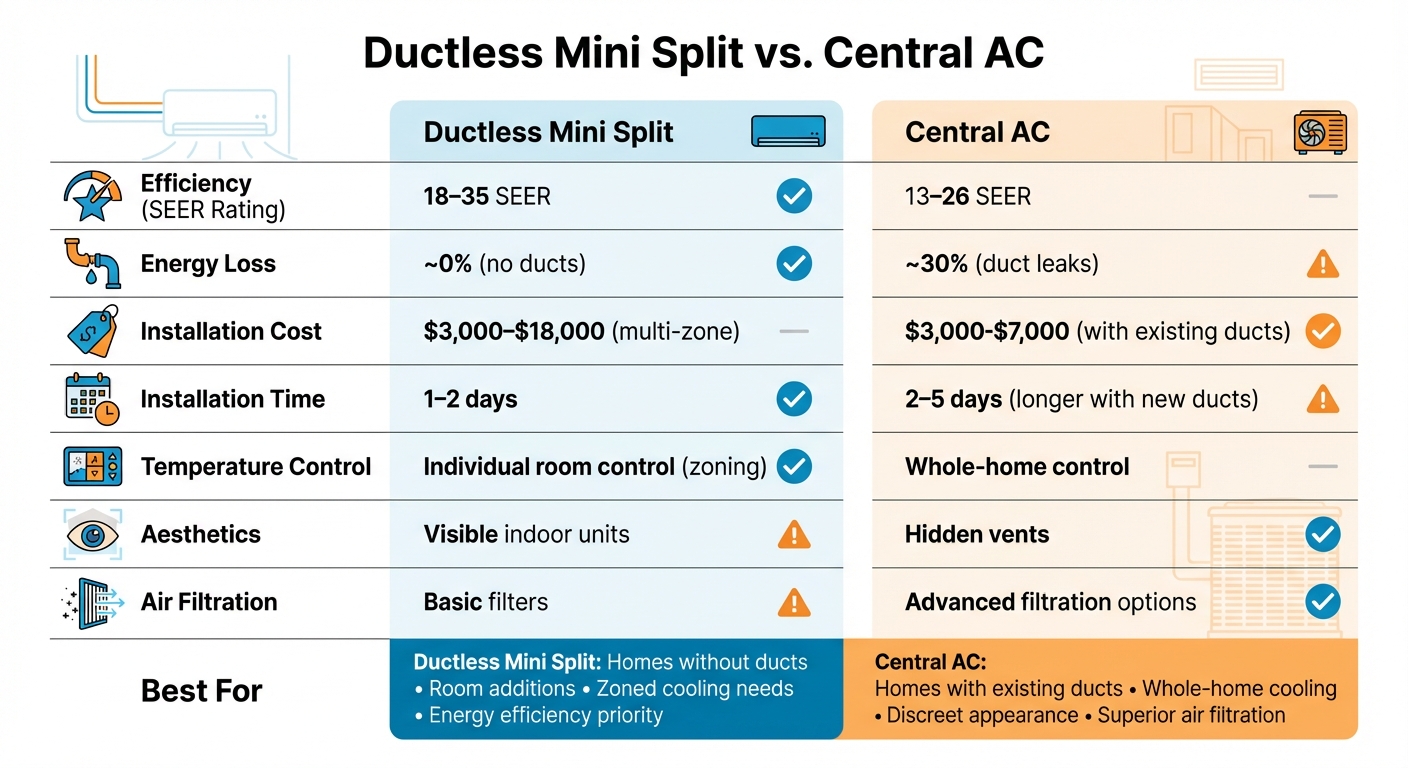
Ductless Mini Split vs Central AC Comparison Chart
Central Air vs Mini Splits: Which One's Better for YOUR Home?
sbb-itb-ab7d5a1
What is a Ductless Mini Split System?
A ductless mini split system is a two-part heating and cooling setup that works without ductwork. It consists of an outdoor compressor/condenser unit and one or more indoor air-handling units (often referred to as "heads"). These indoor units are typically mounted on walls, ceilings, or floors and connect to the outdoor unit via a slim conduit. This conduit, installed through a small 3–4 inch hole in the exterior wall, houses the power cable, refrigerant tubing, and condensate drain.
Unlike central air conditioning systems that rely on ductwork for air distribution, a mini split functions as an air-source heat pump. During summer, it removes heat from inside the home and releases it outdoors. In winter, it reverses the process, pulling heat from the outside air - even in colder weather - and bringing it indoors. Modern systems use inverter-driven compressors, which adjust speed based on demand. This feature ensures consistent indoor temperatures without the constant on-and-off cycling seen in older systems.
"Each head is an independent heating or cooling zone, allowing you to set different temperatures in different rooms or deactivating select zones." - EnergySage
One of the standout benefits of ductless mini splits is their zoned control. Each indoor unit has its own thermostat, so you can heat or cool only the rooms being used. This setup avoids the energy losses associated with ductwork, making the system more efficient.
Main Features of Ductless Mini Splits
Ductless mini splits shine in situations where traditional central AC systems might not be practical. For older homes without existing ductwork, adding ducts can be invasive and expensive, sometimes costing up to $18,000. Mini splits are also a great choice for room additions, such as finished basements, converted garages, or sunrooms. They're especially useful in households where different family members prefer varying temperature settings.
These systems are highly energy-efficient. While standard central AC units typically have a SEER (Seasonal Energy Efficiency Ratio) rating of 13 to 18, mini splits can achieve ratings between 18 and 30+ SEER. Some advanced models even reach up to 42 SEER. This level of efficiency can lead to cooling cost savings of about 30% in homes without ductwork and reduce total energy usage by nearly two-thirds compared to electric resistance heaters. Certain "Hyper-Heat" models can operate effectively even in extreme cold, extracting warmth from outdoor air at temperatures as low as -13°F.
Installation is relatively simple and minimally invasive, often completed in just one to two days with only minor structural work required. Additionally, the indoor units are very quiet, operating at sound levels as low as 19 decibels - quieter than a library. With proper upkeep, these systems generally last 15 to 20 years, and some can even reach 20 to 30 years. However, one drawback is their visible design; unlike the subtle vents of central AC systems, mini split air handlers are mounted on walls or ceilings, making them more noticeable.
These features provide a strong foundation for comparing ductless mini splits to central AC systems, particularly in terms of installation, efficiency, and cost. Up next, we'll dive into central AC systems to explore how they differ.
What is a Central AC System?
A central AC system is designed to cool your entire home using a single, centralized unit connected to ductwork. Instead of relying on individual room units, this system works through three main components: the outdoor condenser unit (which houses the compressor and condenser coil), the indoor air handler (containing the evaporator coil and blower fan), and a network of ducts that distributes cooled air throughout your home.
Here’s how it works: warm air is drawn from your home through return vents, then passed over the evaporator coil, which removes heat and humidity. The blower motor pushes the now-cooled air through supply ducts, where it flows out of registers in your walls, floors, or ceilings. A single thermostat manages the entire process, ensuring consistent cooling throughout your home. In most cases, central AC systems integrate with your existing heating system, sharing the same ducts and air handler used by your furnace.
One of the biggest perks? The equipment stays out of sight. The bulky components are typically hidden in a basement, attic, or utility closet, with only the vents visible. This makes central AC systems much less obtrusive compared to wall-mounted mini split units. However, they’re not without drawbacks - around 30% of cooling energy can be lost through leaky or poorly insulated ducts, especially in hot attics. This energy loss can significantly affect both performance and costs, particularly in Florida’s challenging climate.
"If your home already has ducts in good shape, central AC is often the most efficient and cost-effective long-term choice." - Alex Lane, Home Comfort Advocate
Main Features of Central AC Systems
Central AC has been the go-to choice for most U.S. homes built after the 1970s, largely because it maintains consistent temperatures throughout the house. Whether you’re in the living room or the farthest bedroom, the air is evenly cooled thanks to its centralized design. This makes it particularly effective for larger homes, multi-story layouts, or open floor plans where temperature balance can otherwise be tricky.
Another standout feature is better air filtration. Central systems can handle larger, high-MERV filters or even whole-house air cleaners, which trap allergens like dust and pollen as air circulates. This is a big step up from the smaller filters typically found in mini split systems.
If your home already has ductwork in good condition, installing a central AC unit usually costs between $3,000 and $7,000, with most homeowners spending around $5,000 to $6,000. But if your home doesn’t have any ducts, adding them can raise the cost significantly - up to $18,000 or more.
Modern central AC systems generally have efficiency ratings between 13 and 18 SEER, though high-end models can go as high as 26 SEER. With regular upkeep - like changing filters every one to three months and scheduling annual tune-ups (costing $150 to $300) - these systems typically last 15 to 20 years. For homeowners seeking discreet cooling, consistent comfort, and improved air quality, central AC systems are a solid choice.
Installation Differences: Ductless Mini Split vs. Central AC
The way these two systems are installed couldn’t be more different. For ductless mini splits, the process is straightforward. All it takes is a small 3-inch hole in the wall to run refrigerant lines, wiring, and a drain. The entire installation typically wraps up in just 1 to 2 days. There’s no need to cut into walls, ceilings, or crawl spaces, meaning minimal disruption to your home. This streamlined approach stands in stark contrast to the more complex process required for central AC.
Installing central AC, on the other hand, can be much more involved, especially if your home lacks existing ductwork. For houses with well-maintained ducts, the process is relatively simple and usually takes between 2 to 5 days. But if ductwork needs to be added or retrofitted, it’s a whole different story. Technicians may need to cut drywall, install registers, and seal ducts, which often requires permits and professional inspections. This extra work can add as much as $18,000 to the cost of the AC equipment itself. These installation challenges not only affect the upfront price but also have long-term implications for energy efficiency, as duct systems can lose a significant amount of energy.
"If you need to build new ducts, a mini split will likely save thousands in installation - and energy long-term." - Samantha Reyes, HVAC Specialist
Installation Ease and Costs
The cost differences between the two systems are just as striking as their installation processes. For central AC, the price depends heavily on whether ductwork is already in place. If ducts are intact, installation costs average between $5,000 and $6,000. However, ductless mini splits, while about 30% more expensive per zone, avoid the need for costly duct retrofits and can reduce energy losses by up to 40%. A single-zone mini split typically costs between $3,000 and $6,000 installed, while multi-zone systems for full-home coverage range from $10,000 to $18,000.
For older homes without ducts, the numbers tilt even further in favor of ductless systems. Retrofitting ductwork can add up to $18,000 to the project cost, making mini splits a more economical choice. With a mini split, you’re paying solely for the equipment and a quick installation, skipping weeks of construction. Plus, you eliminate the 25% to 40% energy loss that often comes with traditional ductwork. These cost and efficiency factors tie directly into the broader discussion of long-term operational expenses, which we’ll explore in the next sections.
Energy Efficiency Comparison
Ductless mini splits can deliver up to 35 SEER2, while typical central AC systems range between 13 to 18 SEER, with high-end models maxing out around 26 SEER. For Florida's nearly year-round cooling needs, this difference can mean noticeably lower energy bills. These efficiency advantages make mini splits an excellent fit for the state's climate.
A big reason for this efficiency lies in the inverter-driven compressors used in mini splits. Unlike traditional systems that cycle on and off, these compressors adjust their output continuously, preventing energy waste from constant restarting. This technology enables mini splits to run in longer, steadier cycles, which not only saves energy but also manages Florida's heat and humidity more effectively. Studies indicate that mini splits use about 30% less energy on average compared to conventional systems.
"Ductwork fails spectacularly, wasting 25% to 40% of the energy before it ever reaches its intended destination. That's akin to watering your garden with a leaky hose." - Ryan Mitchell, HVAC Engineering
Central AC systems lose a significant amount of energy - often 30% or more - through duct leaks or heat absorption in unconditioned spaces like attics. In Florida, where ductwork is frequently installed in hot attics, this issue forces systems to work harder to maintain comfortable temperatures. Mini splits solve this problem by eliminating ductwork altogether. Instead, their refrigerant lines lose only about 5% of energy. Additionally, mini splits allow for zone control, meaning you can cool specific rooms rather than the entire house, further improving efficiency.
Energy Efficiency Data Table
The table below highlights the key differences in energy efficiency between central AC systems and ductless mini splits.
| Efficiency Feature | Central AC System | Ductless Mini Split System |
|---|---|---|
| Typical SEER Range | 13 – 18 SEER | 18 – 30+ SEER |
| Maximum SEER Rating | ~26 SEER | 30 – 35 SEER2 |
| Duct Energy Loss | ~30% of cooling energy | 0% (No ductwork) |
| Zone Control | Limited (whole-house cooling) | High (individual room control) |
| Compressor Technology | Single-stage, Two-stage, or Variable | Inverter-driven Variable Speed |
| Dehumidification | Standard (cycles on/off) | High (continuous low-speed operation) |
Cost Breakdown: Upfront and Long-Term Expenses
Upfront Installation Costs
When it comes to installing a new cooling system, upfront costs can vary significantly depending on whether your home already has ductwork. If you're replacing a central AC system and the existing ducts are in good condition, installation typically costs between $3,000 and $7,000, with most homeowners spending around $5,000 to $6,000 on average. However, if new ductwork is needed, prepare for a significant increase in expenses.
Ductless mini splits, while efficient, tend to cost about 30% more per BTU than central AC systems. For a single-zone mini split system, expect to pay between $2,000 and $8,000, while multi-zone systems can go beyond $10,000. In older homes without existing ducts, mini splits often present a more economical option compared to retrofitting ducts, which can cost as much as installing an entirely new HVAC system.
"In the older houses that lack ducts, a ductless mini-split usually has a large cost advantage because it does not incur that huge construction cost." - Rene Langer, Senior Comfort Specialist, PICKHVAC
If you're deciding between repairing an old unit or replacing it, weigh the repair costs against the system's age. Additionally, take advantage of incentives like the federal heat pump tax credit, which provides a 30% credit (up to $2,000) for qualifying high-efficiency systems.
Long-Term Savings and Financing Options
Although the upfront cost might seem steep, long-term savings can make these systems a smart investment. Ductless mini splits, for example, can reduce cooling energy costs by 20% to 40% compared to central AC systems. This efficiency comes from eliminating duct losses and enabling zone control. High-efficiency heat pumps may also save homeowners around $900 annually on energy bills. Over time, the higher initial price of a mini split system often pays for itself within three to five years through energy savings.
To help manage these upfront expenses, companies like West Florida Air offer 0% APR financing with payment plans ranging from 12 to 60 months. Routine maintenance for these systems typically costs between $150 and $300 per year. Keep in mind that central AC systems may also require periodic duct cleaning, which adds $300 to $600 every few years.
Maintenance and Air Quality Considerations
Maintenance Requirements for Each System
Both cooling systems need regular attention, but the specifics differ quite a bit. With ductless mini splits, you'll need to clean or wash the filter in each indoor air handler every 2–4 weeks during heavy use periods. This frequent care is essential because dirty filters force the system to work harder, reducing its efficiency. Additionally, an annual professional tune-up (costing $150 to $300) is necessary to check refrigerant levels and clean the internal coils.
For central AC systems, filter maintenance is a bit simpler. A single, central filter requires replacement every 1–3 months, with costs ranging from $5 to $20, depending on the filter's quality. However, Florida's humid climate brings extra challenges. Ductwork can accumulate mold and dust, so scheduling duct cleaning every few years (at a cost of $300 to $600) is recommended. This is especially important if you notice musty smells or visible dust around your vents. Regardless of the system, keeping the outdoor condenser unit free of leaves, debris, and coastal salt spray is critical for maintaining proper airflow.
Impact on Indoor Air Quality
When it comes to air quality, each system has its strengths. Central AC systems shine in whole-home air filtration because they pull air from every room through a central filter. You can even upgrade to high-MERV filters or install whole-house air cleaners to capture fine particles like pollen, dust, and allergens.
"Ductless mini split systems are less effective at air filtering than a central air conditioner. Central AC systems circulate air from the entire home through a filter to provide better control of your indoor air quality." - Travis Baugh, Digital Brand Marketing Manager, Carrier
On the other hand, mini splits have an edge in Florida's humid climate because they eliminate ductwork entirely, avoiding the common mold and allergen buildup that plagues ducts. Thanks to their inverter technology, mini splits run longer and more consistent cycles, which helps remove moisture more effectively than the on-off cycling of central AC systems. In fact, in dry mode, a mini split can extract up to 4 pints of water per hour, making it a powerful tool for managing Florida's notorious humidity. While their smaller filters can't match the filtration capabilities of central AC systems, mini splits help improve air quality by sidestepping the duct-related issues that many Florida homes face.
Pros and Cons: Ductless Mini Split vs. Central AC
Comparison Table
When deciding between a ductless mini-split and a central AC system, it's all about what fits your needs best. Here's a quick comparison of the key pros and cons for each option:
| Feature | Ductless Mini Split | Central AC |
|---|---|---|
| Energy Efficiency | Pros: Delivers impressive SEER ratings (18–30+) and avoids energy loss from ducts (25–40%) | Cons: Moderate SEER ratings (13–18) and loses 25–40% of energy through ducts |
| Zoning & Control | Pros: Offers precise control for individual rooms with separate temperature settings | Cons: Limited to single-zone control with one thermostat for the whole house |
| Noise Levels | Pros: Operates very quietly, around 19 decibels (quieter than a library) | Cons: Produces a more noticeable hum or drone during operation |
| Aesthetics | Cons: Requires visible wall-mounted or ceiling units | Pros: Discreet design with only small vents visible |
| Air Filtration | Cons: Basic filters in each unit, less effective for whole-home air cleaning | Pros: High-MERV filters enhance air quality throughout the entire home |
| Installation | Pros: Quick and non-invasive, requiring only a small (3-inch) hole | Cons: Can be invasive if new ductwork is needed, potentially adding up to $18,000 in costs |
| Flexibility | Pros: Perfect for room additions, older homes, or specific cooling zones | Cons: Best suited for uniform, whole-home cooling with limited flexibility |
Ultimately, the right choice depends on your home's layout, existing setup, and personal comfort needs. Up next, we’ll dive into which home layouts are better suited for each system.
Best Home Layouts for Each System
The layout of your home plays a big role in deciding which cooling system is the best fit. Florida's variety of home designs means that what works for one property might not work for another. Let’s break it down based on specific layouts and needs.
When to Choose Ductless Mini Splits
Ductless mini splits are a smart choice for older Florida homes, especially those built before central air became the norm. Many historic homes in areas like Tampa Bay lack ductwork altogether, and installing it can be both expensive and disruptive, with costs reaching up to $18,000. Mini splits sidestep this issue entirely by working without ducts.
"Many Florida homes - especially older homes, additions, sunrooms, and detached garages - have no ducts. Mini splits deliver zoned comfort anywhere with minimal installation work." - MiniSplitsforLess
These systems are also ideal for room additions. Whether it’s a new lanai, a converted garage, or a Florida room, extending central AC into these spaces often isn’t practical. Mini splits handle these areas efficiently, avoiding the need for major construction. They’re also perfect for detached spaces like pool houses, workshops, or in-law suites where running ductwork would be difficult or unnecessary.
Another standout feature of mini splits is their ability to provide zone control. They let you cool specific areas of your home independently, making them a great option for tailored comfort.
When to Choose Central AC
For modern homes with existing ductwork, central AC is the go-to choice. It’s the most effective solution for whole-home cooling when ducts are already in place. In these homes, central AC ensures consistent temperatures throughout every room, all controlled by a single thermostat.
Homes with open floor plans also benefit from central systems. These layouts often have interconnected spaces that central AC can cool evenly, without needing multiple wall units. Plus, with ducts hidden behind walls and ceilings, the system maintains a clean, uncluttered look with only discreet vents visible.
Central AC makes the most sense for new builds or major renovations. When ductwork is installed alongside other construction work, the upfront cost is much more manageable compared to retrofitting an older home. These layout-specific considerations highlight how your home’s design directly impacts the choice of cooling system, helping you achieve the best balance of comfort and efficiency, as previously discussed.
Conclusion: Choosing the Right System for Your Home
Deciding between ductless mini splits and central AC comes down to your home's specific requirements, budget, and how you plan to use the system. For homes with well-maintained ductwork, central AC installation typically costs between $3,000 and $7,000. On the other hand, older homes without ducts can avoid the significant expense of adding ductwork - saving anywhere from $7,500 to $20,000 - by opting for mini splits.
"If your home already has ducts in good shape, central AC is often the most efficient and cost-effective long-term choice. But if you're working with an older home, doing a renovation, or only need targeted comfort in a few areas - go ductless." - Alex Lane, Home Comfort Advocate
Beyond installation costs, think about energy efficiency and personalized comfort. Mini splits eliminate duct losses, which can reduce energy costs by up to 40%. Although mini split systems might cost around 30% more per BTU upfront, homeowners often recover these costs within three to five years through lower utility bills.
Your comfort preferences also play a role. Central AC provides steady, whole-home cooling, making it ideal for open floor plans. Meanwhile, mini splits offer precise temperature control for individual rooms, giving you flexibility for targeted cooling.
West Florida Air is here to help you make the best decision for your home. Our team conducts professional load calculations to ensure your system is perfectly tailored to your home's layout, insulation, and cooling needs. Serving Pasco, Pinellas, and Hernando counties, we provide expert installation, maintenance, and flexible financing options. Contact us today for a consultation to find the system that’s just right for you.
FAQs
How many mini split zones do I need?
The number of mini split zones you'll need depends on a few factors, including your home's size, layout, and how you prefer to cool or heat your space. Each zone is managed by its own indoor unit, allowing for independent operation. If you're focusing on a single room, one zone is generally sufficient. However, for larger homes or spaces with multiple rooms, more zones may be required to maintain comfort and optimize energy use. Many systems are designed to handle anywhere from one to several zones, giving you flexibility to meet your specific requirements.
Will a mini split heat well in cold weather?
A mini split heat pump can perform well in cold weather, but its efficiency largely depends on the specific model. Some advanced systems are built to handle extremely low temperatures, maintaining effective heating even when it’s as cold as -13°F to -22°F. On the other hand, less advanced units may have trouble keeping up in such harsh conditions. That’s why it’s important to select a model specifically rated for colder climates to ensure consistent and reliable heating.
Do I need to replace or seal my ducts for central AC to be efficient?
Sealing your ducts is a highly effective way to improve your central AC's efficiency, even if a full replacement isn't necessary. Leaks and loose connections in ductwork can result in 20–30% of air loss, which not only drives up energy costs but also makes it harder to maintain consistent indoor comfort. By sealing and insulating the ducts you can access, you can significantly cut down on these losses. However, if your ducts are in bad shape or poorly designed, replacing them could be the smarter, long-term fix.